Wednesday, January 25, 2012

Forget SOPA... PBS is a teacher's friend

While I love the digital age and begin able to fire up Google and find the answer to many questions, I also long for the days when I could be sure that the media I was consuming was "good." (The bootlegged video of musicians performances on YouTube are OK, but the ones I enjoy the most-- and actually watch throughout-- are those that were produced and edited by professionals.)

So, while SOPA may be intended to protect copyright owners, I appreciate (and support financially) those who create good content and then make it available for web users. To prove my point... PBS has a wonderful collection of digital media that is of highest quality. For example, the feature on the circus a few years ago included several clips appropriate for the science classroom.

Tuesday, January 24, 2012

Animations and education

The iBook discussion here and other places raises questions about human knowledge and understanding. What was knowledge and understanding for previous generations of humans (for even for humans a few years ago) is no longer sufficient.

Consider science and biological processes. A recent TED Talk (unfortunately available as pixelated video) illustrates the point. Through animations such as are demonstrated in this video, students will be able to more completely and easily understand processes. My prediction is they will be be able to learn better qualitatively and quantitatively (they will learn more and more quickly and they will understand details that previous students did not).

Monday, January 23, 2012

National Reading Day


January 23 is National Reading Day...

It might be too late to celebrate the day, but it is never too late to read... the folks at Common Sense Media have a list of recommended books... use the navigation to find titles of interest to middle schoolers!

http://www.commonsensemedia.org/book-reviews 

Bloom 2.0?

This just showed up in my inbox... I would challenge some of the placements and I think Bloom has been misapplied and has largely outlived his usefulness in education (we have far more sophisticated understanding of human learning and we need not progress "up" his taxonomy-- indeed progressing that way may inhibit much learning)... but this can lead to some interesting discussions...

http://www.usi.edu/distance/bdt.htm


iBooks 2 continued...

Over the weekend, my world changed...

I am preparing the final manuscript for a book that is due to the publisher February 1. As part of that project, I am creating apps to go along with it. The Android app was my first effort as I planned to use appsbar which my students have used with success. After a a few hours of work, that apps was "done" (the quotes because it is of course a work in progress).

Last week, iBook 2 was released and with much fan fare, Apple announced its plans for digital interactive text books. My Sunday afternoon activity was to sit at the Macintosh that faces the television so I could watch the Patriots game, and download iBook Author and try may hand at creating an iBook.

It was everything I have come to expect out of Apple's products-- easy to use and completely integrated with everything in the operating system. As soon as my manuscript is completed, I expect the companion iBook will be uploaded so that iPad and iPhone users can access my first iBook.

If you have not seen the whole video introduction to the new iBooks, it is worth an hour of your time.

Please understand also, that I am a fan of Apple's product, but not their shill... I hope you take a look a this because this is the industry-standard and there will be lots of vendors releasing comparable products in the coming months... we have no choice but to understand how this changes teaching and learning.

Friday, January 20, 2012

SOPA continued

In the continuing saga of SOPA in the United States, US Senate Majority Leader Harry Reid has announced that a vote on the bill has been postponed. Most news sources are quoting him as saying "in light of recent events" to explain the decision, and those words are being interpreted as a recognition that the grassroots efforts to petition congress and to "black out" the Internet were effective.

FaceBook for Educators?!?!

Really? Yup...

Finally some educators have stopped and thought about FaceBook and how educators should conduct themselves. I find it interesting that for the first time, there is "someone" recommending that schools adopt a "friending" policy so that educators understand clearly what the expectations are for adults connecting with youngsters in any particular community.

Here is the video introducing the site:

iBook 2

OK, middle school teachers and leaders... your world has changed:


Thursday, January 19, 2012

AC registration info

The registration materials for the 2012 NELMS Annual Conference are available...

http:///pages/conferences/annual/register.html

You can save yourself some money by registration before March 1, and even more if you bring a whole school faculty:

Special School Group Daily Rates are available for 20 or more attendees from the same school - receive a 20% discount. Registration and payment must be received on a single registration form by March 1, 2011. Contact NELMS at 978-557-9311 for further details.

Apple and textbooks

The news feeds are starting to report that Apple has announced iBooks 2- a tool designed for creating interactive textbooks!


http://online.wsj.com/article/BT-CO-20120119-709484.html

http://www.appleinsider.com/articles/12/01/19/apple_plans_to_reinvent_the_textbook_with_ibooks_2_for_ipad_.html

http://www.mercurynews.com/breaking-news/ci_19774487


Technology acceptance model

I have been invited to present a few sessions at the Annual Conference in April, and I am deciding how to overcome some obstacles erected by short-sighted administrators, but I intend to be there to learn from and with a very engaging and innovative community for those days.

The second best part of the NELMS AC is that I get to stop and think about what is most important to me as an educators as I prepare my sessions. One idea that has been helping me to make decisions about what to do in my classroom has been the technology acceptance model.

TAM has been around for years and is widely used in the business world to develop hardware, software, and network systems and also to develop strategies and procedures for using IT in organizations. According to TAM, three factors are associated with the intention to use technology and this the actual use of technology in any setting:


As school and technology leaders (and as teachers) we should attempt to make our technology easy to use and useful. Also, we should seek to increase the expectation that it be used-- be careful, however, as compelling one to use technology does not increase the intention to use technology, nor even the use of it.

Tuesday, January 17, 2012

Seymour Papert-- still relevant

I stumbled across is video on YouTube... what Seymour Papert was saying decades ago is sill relevant... and the thinking that students can do even when doing ostensibly simple activities was useful back then and is useful today... we are fortunate to have Scratch and similar tools available for free.


Wikipedia Blackout

Make your plans now for the end of the world as we know it!

Wikipedia is going to be blacked out to protest SOPA and PIPA.

This is a real "teachable moment" for middle school educators... let's take the chance to talk with students about what this means, let's understand the issues, and engage our students in a real problem.


The Future Looks Augmented - Technology Review

The annual Consumer Electronics Show in Las Vegas provides a window into the future of computing. This slide show from Technology Review that shows some wearable devices is evidence of that future. These devices have been held up as models for a few years, but now they are entering the consumer market. It won't be long until we contemplate their role in education (or some of us will- others will surely be waiting for the next version of Word to be released).

http://www.technologyreview.com/article/39472/page9/#photo


- Dr. Gary Ackerman

Monday, January 16, 2012

Internet on strike

A bill under consideration by the US Congress is causing some consternation among many Internet users. The Stop Online Piracy Act. Opponents of the law suggest that it will severely limit freedom of expression, which has been a cornerstone of Internet engagement since it was first developed.

It appears that the Obama administration is going to oppose the law, but it also appears that the owners of many web sites plan to take their sites off line to protest this and other attempts to censor the Internet.

Maybe you had better plan now for potential disruptions... better yet, use any disruptions as an opportunity to discuss censorship with your students:

  • What rights should owners of content have?
  • Does restricting access to content promote or prevent innovation?
  • How can one make money by sharing?
Strike Against SOPA!


New 'net domains...

Again, the changing nature of the digital world has my attention. NPR has a good report on the proposal to allow anyone to create an Internet domain... so that our "limited" options now (.edu, .com, .org, .name, ...) would be expanded and limitless (I could register .ackerman).

As the report points out, the question is becoming who controls the Internet. Of course, many of us fund that a chilling question. First, it points out that no one currently "controls" it; there are standards and groups that define the standards, but that is different from controlling it. Standards simply are the protocols that engineers must following of they want their systems to be compatible with the 'net.

Second, it points out that some want desperately to control what information we access. Previous attempts to filter the 'net have not been successful, but there is much at stake, and so those who seek to control what we access keep trying.

Friday, January 13, 2012

Flat World Knowledge

The world is changing... there are several locations on the web where users can access open source textbooks... these are usually written by teachers and professors (usually these people are from higher education) for use in their own classrooms and they share them with anyone. Flat World Knowledge is the most recent collection I have found... seems to have some good stuff that can supplement our classrooms.

Buying high-tech

Common Sense Media also has a good guide to buying high-tech toys... together with the reading resource (see below) the common sense media folks have some good stuff to share with middle school parents.

Reading

The folks at Common Sense Media have a page entitled "How to Raise a Reader."

The examples they give seem geared to students a little younger than our target here in the nELMS community, but the advice is sound and can be adapted... and yes, reading aloud is still fine in middle schools.

I recall fondly the team that I first worked on... we would "Adopt an Author" and for a few weeks take our 20-minute silent reading period after lunch and each teacher read a favorite author-- Edgar A. Poe's short stories was the fare in my science class!

Thursday, January 12, 2012

Quality Counts 2012

EdWeek has been publishing its quality counts reports for more than a decade, and it is their effort to summarize "the state of education" in the US.

The 2012 edition is out, and my initial reaction is "ho-hum." It seems more of the same.


  • The rest of the world is moving ahead, and we are stuck with mediocre performance, especially in science, technology, engineering, and mathematics. 
  • We are "making progress" on issues like teacher quality, equity, and funding; but we still have a long way to go.
It sure seems to me that this could have been written at any point in my career. It sure seems to me also, that if we are ever going to be serious about reforming education, then we will be forced to ask questions that cut to the core of what human learning is and how it occurs. That will also cause us to recognize that the education I had (in the 1970's-- I graduated from high school in 1983) is not appropriate for my kids.

Hello??!?-- it's 2012!

Please excuse the personal rant, but...

I am going through the relicensing process this year. ow, I have no problem with documenting my professional learning; I have no problem with reflecting on it... I am looking back on my dissertation experience and connecting that with my work as an educator.

I do have a problem, however, with filling out paperwork BY HAND! Hey it's the 21st century, let's make a web site with the forms that are necessary... allow me to enter the information once and then copy it as necessary. Let's make the site check to be sure that I have entered information in all of the correct spaces and then allow me to print my forms so that our local board can review the contents.

This rant is not about the people on the board or the process... it is about the hypocrisy of educators' talking about how we are reinventing school for the 21st century, but we do not apply technology to a redundant task for which it is perfectly suited.

Let's do a little math... each teacher spends let's assume 8 hours getting relicensing paper work together... and in Vermont that is each 7 years... so let's estimate 1 hour per year doing relicensing paperwork. Let's assume an average teacher is paid $40,000 per year and that gives an hourly rate of about $31 (figure 184 days per year and 7 hours per day).

If we hired a goo web programmer (or even a hack like me) for a week (let's pay 'em $60 per hour for 40 hours-- $2400!) we could probably cut the paperwork time by 60%, and save everyone time and money!

Sorry for the rant... I need to get back to writing the name of my university on stacks of paper for the relicensing board to review next month.

Wednesday, January 11, 2012

AC Reminder

Friends in the NELMS office are starting to talk about the upcoming annual conference--- Steve tells me the brochures are heading off to the printer and it must be getting close as we are talking about a trip to Fenway Park!


31st Annual Conference
Rhode Island Convention Center, Providence, R.I.
April 2 & 3, 2012


Visit the AC page of the NELMS web site

Curriculum standards-- big sigh...

I understand the rationale behind curriculum standards... someone to tell us what we should be doing... some "data" we can pint to when individuals in our communities question us...

Despite my understanding, I am questioning the appropriateness of our current focus on standards. Right now, I can point to three strands of evidence that are personally relevant:

1) Our state "refreshed" their technology standards a few years ago... just before they did, I had students review the previous set, and their response was laughter... seriously, they laughed at how silly the "skills" were and they were able to demonstrate those far above their grade level and they were commonly using technology in ways that were not even mentioned in the standards. Guess what... they are beginning to have the same responses to the "refreshed" standards. Despite that, our administration is pointing to those standards as "the guiding light" of our renewed interest in technology.

2) I am reading a book in which the author argues that the standardization of curriculum is a deviation from the localized needs students and families that was the original intent of education in our society. According to the author, the centralization of education has contributed to a huge economy and bureaucracy supporting itself.

3) A recent entry on EdWeek suggests that a group has published set of standards for human sexuality education. Please do not assume I am somehow opposed to sex education, I simply know that standards ted to contribute to what is described in point #2 and we have too much in the curriculum already... my old middle school mentors who taught us "less is more."

Tuesday, January 10, 2012

Little Alchemy continued

Recently, I posted about Little Alchemy, the Chrome App in which players mix and remix different elements to make new ones (e.g. earth + fire = lava). I still think it is a good game, but my students did find some mixtures that may be a little questionable (human + human = sex). I general, however, I found this to be a safe place to have a discussion with 5th graders that sometimes there are things we find online that we may not be appropriate and the best way to handle it is often, to just ignore it an move along without getting goofy about it and causing everyone else to be distracted by it.

CodeAcademy

Ever since reading Douglas Rushkoff's Program or Be Programmed a couple of years ago, I have tried to give my students experience writing programs. My rationale is simple-- if we understand how to control technology (and even that we can control technology), then we are going to be more empowered and less likely to be controlled by technology.

As part of my adventure to introduce programming to students (especially I have found middle school students accepting of programming) I am always on the lookout for tools to teach programming-- especially those that allow for no threshold and no ceiling (anyone can follow along and there is no limit to what you can do).


CodeAcademy appears to be one that deserves some attention...

It has also been featured on Wired recently...

Monday, January 9, 2012

Technological Healing

Considering my post earlier today about my switch to iPhone from BlackBerry, I was interested to read this article (on my iPhone) regarding handhelds and health care. Now this may seem out of place on a middle school education blog, but I think it illustrates the meed for educators to adopt a more active and proactive stance towards technology in our lives.


I thought you might be interests in the following story on TechnologyReview.com:

"Technological Healing"
A leading researcher says digital technologies are about to make health care more effective. But is so much data really beneficial?

http://www.technologyreview.com/read_article.aspx?id=39320&a=f

To view this story, click the link above or paste it into your browser.


- Dr. Gary Ackerman

Games!?!?

As I have been looking around at apps for Google Chrome for the last few months, I have noticed the number of games that are around and I am beginning to wonder about the role of arcade-style games in teaching (for example) math facts and the transferability of the skills that students develop (assuming they do develop such skills) to other areas... I wonder if students with practice math games for 10 minutes per day would be measurably better at say adding the costs of items in a shopping cart.

It sure seems that such a research study would be a good one for a graduate students somewhere.

New iPhone

I have been a BlackBerry user for about 5 years... I used it for the typical smartphone purposes-- SMS, keeping notes, accessing mobile web sites, email, posting to this blog.

My kids have been using iPhones for several years. It just happened over the holidays that we were eligible for an upgrade of phones, so I used it to replace my BlackBerry with an iPhone. I wish I had made the switch much earlier. We know that technology that is easier to use is more likely to be used, and the ease of use is what I am most impressed with while using the iPhone. The interface is easier to use and the natural movements allowed by the touch screen allows for far more efficient interaction than the joy stick of the BlackBerry.

Also, Siri and the rest of the voice-enabled functions (esp. notes) make me wonder why we don't give such devices to all students.

And email

Test from the iphone
- Dr. Gary Ackerman
Testing blogger from my iPhone

Friday, January 6, 2012

You can't be my teacher

One of my favorites-- this kid is great!

\

Digital Learning Day

A group called Alliance for Excellent Education is promoting Feb. 1, 2012 as the first Digital Learning Day.

Check out the idea in the first sentence here-- replacing textbooks with netbooks will do noting unless we change what we do and how we do it.


High-tech "toys"

Yesterday afternoon, a colleague asked me about a seemingly simple question: where do I plug the mouse in to my iPad?

It occurred to me that there is a change that has taken place and many people (make that many adults) are not aware of the change. The tablets and handhelds that people carry around and use to connect to the Internet are not the same devices that we have come to know as computers. Keyboards are "on screen" and only available when the user "asks" for them. Mice are replaced with touches on screens. Apps are programs for very specific purposes-- this is different from the applications we install on our desktops that can be used for almost anything.

I sent my colleague to this article that was on the Common Sense Media page last fall... it is a good introduction to the e-readers, tablets, smartphones, game consoles, and learning tablets... all of the digital devices young people are using today that are different form the computers we used when we were growing up as computer users.

Thursday, January 5, 2012

Rick Wormelli and NELMS


The always popular Rick Wormeli will be back in 2012!

Differentiation and Motivation

February 2 & 3, 2012
Sturbridge Host Hotel, Sturbridge, MA
November 13 & 14, 2012 (location TBD)

World is changing

So I have a student who is serving "in-house suspension" today-- I know let's not get into the reasonableness of removing a students from class.

He was working on a essay using Google Docs and I was editing it along with him... now I wonder if we violated the "in-house suspension." I would expect that a student serving such a suspension would have done something to be removed from class for the day... my question is was he removed if I was still able to interact with him?

Some more predictions for 2012

The collection of "predictions for educational technology in 2012" that are crossing my inbox grows...  this collection from ZDNet points to a few things that I agree are coming and coming fast-- the question is how long the too-deeply entrenched practices will be able to keep these at bay:

1) Given the interest in data-driven decision-making, then the prediction that the algorithms used to make business decision will make it into education decision-making is probably a good one. I do not, however, think that it will necessarily result in "better education" for students. Important cognitive functions like being flexible and creative are not easily made into algorithms (not yet at least). If we develop powerful tools to analyze education data, we will have the illusion of education, but not the reality.

2) Tablets-- yup they are coming and we had better be ready for it!

3) BYOD is coming-- yup-- students have powerful computers in their pockets and we need to use them.

4) Khan Academy-- yup-- those lessons are good and making many teachers irrelevant.

5) Goodbye libraries-- no, I think libraries and the guidance good librarians give in finding and using good information sources are going to be more important as we move forward.

Trends in digital learning

I have been plowing through some things that showed up in my inbox before the holiday break and have been interested in the number that focus on the trend towards online learning for everyone. There are questions about how credible virtual classrooms are, there are questions about the extent to which teachers are being prepared to teach online. While I recognize those are being things we might care about, I think they miss the point. I think the issues are these:

Young people today live in a digital world-- their brains are changed (literally) by their expose to digital information-- we must ask if the traditional definitions of "credibility" and literacy and numeracy are still valid in this world.

Teachers need to develop skill at "transitioning" from what they are doing to what they should be doing... when I first started teaching, I had a mentor who told me to "plan a lecture" so that everything you think is important is down and then "figure out how to teach it without lecturing." He also suggested doing this anew each time I taught a lesson to get in the habit of thinking about "alternatives" to lecturing. I find myself doing that today with digital technologies-- what do I want my kids to know and how do I do it with digital media so that I am working in their world.

Virtual Schools

Teacher Prep

Wednesday, January 4, 2012

Top 10 stories of 2011...

EdWeek has posted their top 10 educational technology stories of 2011... things like iPads, cyberbullying, virtual learning.

I think these are all issues that we are dealing with, but also are rather superficial compared to what we are going to be recognizing and dealing with in the coming fews years:

Computers have undergone a fundamental change-- whereas they were once devices for information access (and creation and sharing), they are now devices for interacting.

Whereas computers were big expensive devices that were controlled by technicians, they are now small and cheap and controlled by users.

Whereas adults were once the most knowledgeable users of information and technologies (and the most experienced learners in the classroom), young people are ow the most dynamic users and learners in the classroom!


Comic Master-- interesting writing tool

Graphic novels are popular among some young people today... Comic Master is a site that a colleague sent my way recently. Create an account, log on, and use the tools they provide to create your own.

I have students creating biographies right now... we are starting with the familiar and are going to try some other more interesting tools such as this to make "boring" assignments more interesting. Look for further updates on our progress.

Tuesday, January 3, 2012

Save the internet

The world is changing...

iPhone arriving soon!

As I mentioned a couple of days ago, we are updating our computing resources in my house... my iPhone has shipped, so that part of the updating will be done soon.

As I have been messing about with my kids iPhones, I am struck by the convergence of the devices-- one device that we carry in our pocket is capable of being our phone, and calendar, and Internet device, and calculator (with great voice-activated capacity thanks to Siri and Wolfram Alpha), and camera... and anything else we buy and app for.

Monday, January 2, 2012

Join NELMS

With the start of the new year, consider joining NELMS... the leading organization for educators of young adolescents in the region.


and don't forget...

31st Annual Conference
Rhode Island Convention Center, Providence, R.I.
April 2 & 3, 2012


Google Correlate

Some estimates are that Google handles close to 50,000 searches per second! That represents an amazing data set, that can now be searched using Google Correlate... basically, enter a search term and find other terms that are correlated with your term (complete with values for r-- hey that is a great introduction to that value!).

It sure seems to me that this represents a change in the nature of the information we can access here in the 21st century and it points to the need for educators to refresh out curriculum and instruction.

Morning Edition, the NPR program, included an interesting story on Google Correlate on Jan. 2, 2012.

Friday, December 30, 2011

New computer arrived today!

Our holiday gift to the family was to begin updating our computer resources... this will be a several-month process.

The first item as a Mac Mini to replace a 7-year-old PC that is shared by everyone in the family. We bought it from a vendor who bundled with it some RAM. I was amazed at the design of the Mini and how easy it as to open and install the RAM-- by far the easiest machine I have ever opened. As soon as the monitor arrives (tracking information says its is out for delivery), it will be booted up and ready to go.

Next on the list is ordering an iPad for my wife and I (the kids already have them). I expect my younger son will accept a MacAir as his high school graduation gift in the spring, and then I will complete the upgrades with another MacAir soon afterwards.

Thursday, December 22, 2011

The paradox of progress...

I understand "continuous improvement."

I write, and so I know the meaning of a "work in progress."

Unfortunately, I think the concept of progress has been captured by individuals who use smoke and mirrors and talk and talk and talk, but never do anything. Recently, I have been hearing and seeing and reading about school in which "we are making progress." Closer examination, however, reveals that leaders in those schools are holding meetings and talking about change, but students and parents and teachers are seeing nothing.

I am not a fan of "checklists" of things that have been accomplished (I tend to adhere to Einstein's adage "what you can count doesn't matter and what matters can't be counted"), but at some point, progress or claims of progress must be examined against reality. My friend who is a musician rehearses all the time, but at some point, he must get on the stage and perform, and his audience judges his performance. When we accept "we are working on it" as evidence, we have begun to accept stagnation.

Neuroscience and teaching

Cognitive scientists have been busy in recent decades and they have elucidated the workings of the brain. Some of those discoveries are surprising and somewhat disconcerting to educators as they challenge much of what we have thought for generations and how we have designed curriculum and instruction for those generations. Wendi Pillars has a piece on Education Week's Teacher Leaders Network currently that points to several ideas that we need to recognize and accommodate:


#1. Teachers are, in essence, brain changers.
#2. The one whose neural pathways are changing is the one doing the learning.
#3. Critical thinking is more important than ever—which means we expect different results from learning.

I would add a few more points:

Learning is a social endeavor-- what we know and how we know it is deeply connected to who is around and how we interact with them when we learn it. You have experienced this. Two brains are indeed better than one as you brainstorm and knowledge emerges from the group that would have been impossible alone. Evolutionary social biologists have concluded that the human brain evolved for social interaction. Playing well with others matters and your brian is designed to play well with others.

Humans learn from and through their technology-- what we build influences what had how we think to an amazing degree. The adage "necessity is the mother of invention" is in many ways backwards. Once we invent something it becomes necessary. Consider the algorithm we were all taught for adding (stack the digits according to place, sum and "carry" as necessary) is necessary only because we have invented systems of accounting in which large numbers must be accurately recorded. 


Wednesday, December 21, 2011

Computing like it's 1999!

So, there is something wrong with our network at school today... probably a virus or bot that is hogging the bandwidth is what the tech folks say... I have spent half the day downloading a 21 MB install... I have watched a few lines of web pages load and then the content loads in a series of cascades down the page... makes me think it is 1999.

Authenticity in education...

I have been trying (with dubious success) to convince "leaders" in education that we must adopt more authentic projects than are allowed by those who are too narrowly focused on tests scores. My students have been creating apps for mobile devices recently, and their culminating project was to create an app for a business. We have a grant-funded position in the building this year to work on career-readiness and to help our students find internships and other alternative paths to graduation, so she contacted some businesses and got their approval for our students to create and publish apps for them.

One of our students received a phone call from the owner of one of the businesses yesterday to say that his company (a towing company) had actually gotten a client from the app! Someone whose car slid off an icy road found the app and had their car pulled out of the ditch because of it.

"That's cool," I said to the student. "Yeah it is," was his response-- and he had a gleaming smile!

Discover more Android apps

Eduction is changing!

Market Place, the program I heard on Vermont Public Radio, had an interesting story about the role of technology in education. It focused on the opportunity to individualize education with online video, especially. This story reinforces what is to me going to be the primary function of schools in the future (and this is different from our current function in education).

The work of "instructing" students is going to be done by others-- probably on video-- who are better than instructing than we are. Their instruction will be available anytime and anyplace. (In the past few years that I have been teaching physics I experienced this as my students and I watched Walter Lewin's lectures on YouTube.)

The work of teaching will include setting the context for that instruction and helping learners to apply the lessons in that instruction to authentic and relevant problems. (My physics students and I spent much time in class designing experiments and demonstrations of the physics in Lewin's lectures.)

The difficultly for educators right now is the transition... many entered education because the enjoyed and excelled in "schools as instructional places," and they were prepared to work in those settings. Unfortunately, those setting will be preserved and experienced as museum exhibits in the coming years.

Tuesday, December 20, 2011

eBooks

A colleague sent me this link... this is a terrific list of sites from which to download ebooks.

Common Core deserving a closer look?

I always get nervous when "the new standards" are coming. This is an event that has happened several times over my career and it is always the sign that nothing is going to happen for a few years: We hold off on making any decisions about what to do or how to proceed on school improvement because we need to see what the new standards say... we also assume that the new standards have the answers that we have been waiting for.

The Common Core is the next best thing as far as standards are concerned... and it appears that we need to be skeptical.

Of course, I am not the best person to ask about this... I figure I know as much about technology and the role of technology in society as anyone who is making curriculum decisions. When my students and I look at the curriculum standards for computers and we find that my students are creating authentic projects  in which they demonstrate performance at grade levels higher than they are enrolled (and the kids are engaged and enthusiastic while doing it), then I figure I am safe in ignoring the standards and doing what I know is best for my students.

Bad humor in the 21st century

FaceBook is an interesting way to share news. In the last several years, I have been informed of several situations by FaceBook--- the deaths of individuals of local worth, accidents, births, you get the idea. In general, the news that comes around is reliable. But then...

Last night, I watched the pre-game show before Monday Night Football as my kids and I look forward to the bit they always do looking at funny events from the weekend (C'mon Man.) I then went to my home office to work on my book that is due to the publisher in a few weeks, when my wife came down and said, "someone on FaceBook just said there was a terrorist attack at the football game."

We rushed to turn the TV back on only to find that a transformer had malfunctioned (and that makes an impressive display in the night sky if you have never seen it) and there was a power outage at the stadium. I guess the lesson is that everyone having the capacity to "report and disseminate" information is wonderful, as long as the information is accurate.

Monday, December 19, 2011

Vygotsky and education

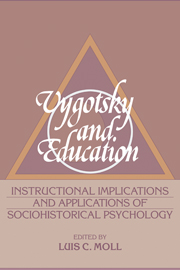
Last spring, I finally purchased a copy of Vygotsky and Education, the 1990 collection edited by Luis Moll. It sat on my "to read" pile for six months... I finally started it over the weekend, and I am kicking myself for not reading it years ago!

The chapters are divided into three parts. The first deals with the social and historical aspects of his life-- very appropriate for the scholar who focused his work in education to the role of social interaction in learning. The second part deals with the educational implication for Vygotsky's ideas. The third with instructional applications.

Although the first few chapters are interesting, the first that should be required for all educators is chapter seven, "Teaching mind in society: Teaching, schooling, and literate discourse" by Rowland Gallimore and Roland Tharp.  They remind us what the zone of proximal development is and argue that teaching should be the work of improving performance. Improved performance is observed at the interface between everyday experience and scholarly learning; the recitation that we find typically in classrooms (and that is promoted in today's test-focused system) is not the performance we need to improve.

Much of the book is available on Google books, including most of the chapter that I say is first on the "must read."

Today's libraries

On occasion, I go to the library at the local state college... they have a pretty good education department, and so their stacks have plenty of good resources...

I have noticed that students are beginning to use the library as a research and collaboration space in a way that was unacceptable when I was a student. Students gather to work and write... and talk.

I suppose we can consider it a sign of the times and a 21st century reality. I miss quiet libraries and I still find them whenever I can, but I recognize that much of the work I used to do in the library, I can now do at home. When I visit the local college library, I have a list of books I want to read and I know the call numbers and I know if they are available or not.

Favorite words apps for Chrome

My students and I are taking some time off our usual projects-- actually those who need a chance to fix projects and resubmit them have some "catch-up" days this short week.

We are playing some word games using Chrome Apps... here are our favorites:

Word2 (that is word squared)

10-Letter-Words

Word Joust


Friday, December 16, 2011

YouTube

On the outside chance someone has not heard about this yet, YouTube is making its tools customizable for educators...

http://www.youtube.com/teachers

Is designed to help teachers make and share playlists of relevant videos.

http://www.youtube.com/schools

Is deigned to help schools control who sees content they create and how teachers and students see YouTube content.

Some fun stuff...

Here are a couple of interesting sites that folks have been taking about and using in my school recently.. not sure they are terribly useful for all middle school kids, but I can see several interesting uses...

http://illustmaker.abi-station.com/index_en.shtml

http://www.buildyourwildself.com/


Concrete poetry

A colleague showed me this site recently... not fancy, just easy, useful, and fun!-- Hey that makes a tool that we are likely to use and to continue to use!

  Concrete Poetry-- take a picture, add words... make poetry

Thursday, December 15, 2011

PowerPoint wastes money? wait!?!?! what!?!?

TED is an amazing resource... YouTube for thinkers is what I like to call it. Every now and then, there is a TED Talk that makes some amazing points. John Bohannon's modest proposal demonstrates the value of the arts while questioning PowerPoint... if you get bored by the first few minutes of talk about science and atoms that are at absolute zero (which is anything but boring) you can skip ahead until about 6 minutes when he talks about the $250 million per year cost of PowerPoint and the illusions that accompany it... think about his assessments and use those as a lens the next time someone starts up PowerPoint in a faculty meeting.

After watching this, I am thinking John Bohannon needs to be hired as a consultant for middle school reform-- you know to get middle school back into middle school!

Rethinking 21st Century skills...

For the last several generations, the skills needed for "success" have been rather stable and well-known... reading, writing, arithmetic... Daniel Pink calls them linear skills. Basically, score well on the SAT and you are pretty well assured of being a success in business or organizational leadership. Get through high school by being able to follow direction, get to where you need to be on time and complete the assigned academic task, and you will be able to find a job working in one of those businesses or organizations.

(At least that worked for my family-- my father was a truck driver in a Teamster shop, my mother became a bank officer with some education beyond high school. My brother went to college and became a grocery store manager, I became a teacher.)

The times really are changing, however, and that model is begin challenged on many fronts. I cannot be sure my sons (a junior in college and a high school senior) will be able to rely on such a path through life. I read and hear lots about 21st century skill, but the people who seem to have the best advice are those who are arguing that a whole new set of habits of mind are necessary for the innovative and creative thinker and leaders that society needs in the coming decades.

Daniel Pink and his Whole New Mind is one such person...

Steven Hall and Wisdom is another...

This article in EdWeek points to some ideas I had not seen from Howard Gardner that creativity, discipline, synthesis, respect and ethics are ways of knowing appears to be another... along with some other emerging research.


Wednesday, December 14, 2011

#homework

In my school, we are revisiting a discussion we had a couple of years ago... using cell phones. Two years ago, some colleagues and I experimented with academic uses of cell phones:

We had students "taking notes" o a field trip by posting to a blog-- before they left we had associated with their phones with a blog on blogger and they uploaded photos and reflections...

We had students uploading "notes" during a video (Jesse Schell taking about games)...

The results were interesting... but now the issue has appeared again because it seems students were sending answers to each other during a test... my response now is what it was then:

If students can pass your class by performing simply on tests in which the answers can be passed back and forth, then you are probably not having them perform useful tasks. Chris Toy, the educators from Maine who speaks so well about technology issues, describes a simple solution... sometimes class is a place-your-cell-phone-on-the-desk-where-anyone-can-see-it day. Other times class is a make-sure-your-have-your-cell-phone-cuz-we-are-gonna-use-it day... (actually that is my interpretation of his message and that is the way I have translated it for my students).

Now I am starting to read how students are adding hash tags to their tweets so they can get and give homework help! Cool!

iPads and textbooks...

There has been some conversations on a listserve to which I subscribe recently in which IT folks in schools are talking about the "problem" of lost/stolen/dropped/ or otherwise damaged iPads and laptops... the general consensus is that youngsters are far more responsible users than adults are! My observations seem to confirm that... and the responsibility extends beyond just physical use... yes I observe students listening to music while they work, but students genuinely want to become more skilled users of computers. When they are assigned a task, they work on it. When I observe adults with computers and they are assigned a task, they a checking email, shopping, booking plane tickets, doing just about everything except what their task is.

Tuesday, December 13, 2011

Protect IP-- Internet law

This has been on my radar for some time, and I thought others were aware as well... in conversations with others folks recently, I know now that some folks who should be aware are not, so...

PROTECT IP / SOPA Breaks The Internet from Fight for the Future on Vimeo.


Storytelling through history...

In this recently posted TED Talk, Joe Sabia tells an entertaining history of storytelling... and the technologies humans have adopted and replaced as storytelling tools. His interesting conclusion is that the stories remain and that we become more human as we use storytelling tools.


Little Alchemy -- Chrome App

Every time I turn around, my students are finding for me another interesting Chrome App-- yesterday students who had finished a project were playing Little Alchemy. This is a game in which players mix elements to make new elements.

Monday, December 12, 2011

21st century media

On of the great things about being alive in the 21st century is that we have the chance to see and share amazing images from around the world with ease.

This is especially true with particular events and transitions... for example "the moment" was a project a few years ago in which people shared their photos of the moment when President Obama was inaugurated... her is another example... a 2011 year in review...

http://www.washingtonpost.com/national/2011-defining-moments/2011/12/08/gIQAa8xwfO_gallery.html


While these are not new, when I was a student, we were limited to watching these on television or seeing them one viewer at a time in magazines... I like today's choices much better.

BioDigital Human-- Chrome app

In my on-going rants about my favorite Chrome Apps, I have to mention BioDiogital Human... a 3D body that you can rotate, navigate, and share. Currently, there are a few animations that can be used to watch (for example) a golf swing. Users can change the gender of the model and select the body systems to be displayed. This really makes me miss teaching science.

Friday, December 9, 2011

5 tips for next year...

Nora Carr on eSchoolNews has suggested five tips for using technology in the coming year...

1) Use quick response codes... like this one for the NELMS web site:


2) Free up social media... you mean allow teachers to access FaceBook? (When I get home I will post a link tot he NELMS Group on FaceBook... I can't do it from school!)

3) Understand to adapt to the Millenials.

4) Try something new... and may I add that the recent suggestion (by a principal who fancies herself innovative and creative) that teachers commit to using technology in their classes once a month is a great way to move yourself forward to say 2002... the new cannot be something new to you but old to others... find a cutting edge technology an use it.

5) Adapt.


21st century information-- Chrome apps

I grew up as a scientist... from the time I entered middle school (which they called junior high school), I was curious about the world to an extraordinary degree and I was enthralled by the tools and the ideas used by biologists and physical scientists to understand the world... and I still am.

Given this history, I actually like the periodic table (despite the fact that chemistry is my least favorite science... give my biology first, physics second, and if you can mix in some Earth science even better... chemistry not so much). It organized some very complicated ideas about the world around us and gives meaning to seemingly disconnected facts. As a teacher of the sciences, I get how the periodic table makes little sense when first introduced to it.

One of the great advances in humanity that we have had the pleasure of observing is the change from cumbersome and sources to highly mobile and easy to use sources... as an example, I point to the several periodic tables available via Chrome App and also via cell phone and every other mobile device...

Her is one that is an excellent example:
http://www.ebhasin.com/apps/apps-source/Advanced%20Periodic%20Table/src/index.html


Save money this season

More great advice from the folks at Common Sense Media... they have six pieces of advice for the holidays... things like go the the library!

This is a great list to share with middle school families...

... and if you are planning to spend money... they have advice on appropriate apps for iPhones and Androids...